The Digital Self-Service Model (And How One Agency Used It to Eliminate $140,000 in Annual Service Tax)
On this page, We’ll show you the system that allows your clients to handle 70% of their own service requests—without picking up the phone, without waiting on hold, and without bothering your CSRs.
Let me ask you a question:
When was the last time you called your bank to check your account balance?
Probably never. Right?
Because you have a mobile banking app. You open it, check your balance, transfer money, pay bills, download statements—all without ever talking to a human.
But it wasn’t always like this.
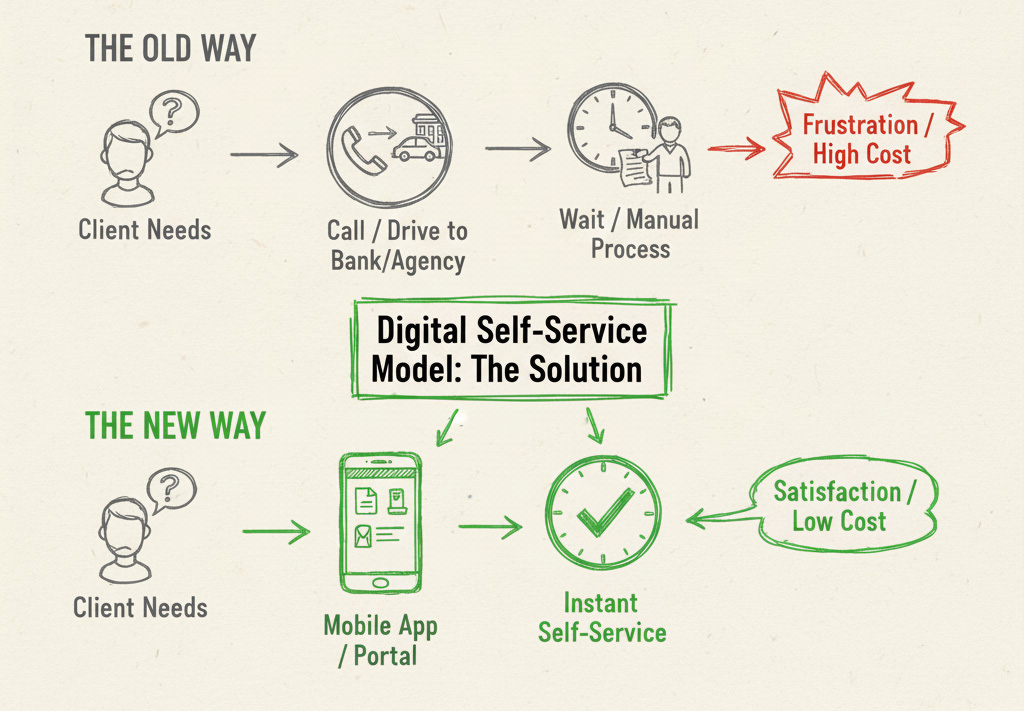
Twenty years ago, if you wanted to check your balance, you had two options:
- Drive to the bank branch and wait in line
- Call the 1-800 number and wait on hold
Either way, you were forcing the bank to use expensive human labor to answer a simple question that you could have answered yourself if they’d just given you access to the information.
Banks were bleeding money on customer service costs. Tellers were drowning in transactional requests. Wait times were terrible. Customer satisfaction was low.
Then mobile banking apps changed everything.
Now, 90% of banking transactions happen without a human ever touching them. Customers love it because they have instant access. Banks love it because their service costs dropped by 70-80%. And here’s the kicker:
Customer retention went UP, not down.
Because nobody wants to go back to the old way. Nobody wants to leave their bank that gives them instant access at 10 PM on a Saturday for a bank that forces them to call during business hours and wait on hold.
Self-service didn’t hurt customer loyalty. It INCREASED it.
Now let me ask you this:
What if your insurance agency could do the same thing?
What if your clients could pull their own certificates of insurance at 10 PM on a Saturday—without calling your office, without waiting for Sarah to get back from lunch, without leaving a voicemail that won’t get returned until Monday morning?
What if 70% of the transactional requests your CSRs handle every single day could be handled by the clients themselves—because they WANT to do it themselves?
That’s exactly what the Digital Self-Service Model does.
And just like mobile banking, it doesn’t hurt your client relationships. It strengthens them.
Because you’re no longer forcing your clients to jump through hoops for simple tasks. You’re giving them instant access. You’re making their lives easier. And you’re freeing up your CSRs to do the work that actually matters—the work that builds relationships, prevents churn, and generates revenue.
DEFINING THE DIGITAL SELF-SERVICE MODEL:
Here’s how it works:
The Digital Self-Service Model is a client portal system that gives your clients 24/7 access to:
- Certificates of insurance (pull them instantly, no waiting)
- ID cards (download them from their phone in 30 seconds)
- Policy documents (declarations pages, endorsements, everything)
- Billing information (see what’s due, when it’s due, make payments directly)
- Policy change requests (submit requests without calling)
- Claims assistance (file a claim or request roadside assistance directly through the portal)
All of this happens without your CSRs lifting a finger.
Your clients log in. They get what they need. They’re happy because it’s instant. You’re happy because you didn’t pay a CSR $28/hour to pull a document that took 10 minutes.
But here’s what makes this different from the “customer portals” you’ve probably tried before:
This one actually works.
Most agency management systems have portals. And nobody uses them. You know why?
Because they’re clunky. They require separate logins. They’re hard to navigate. And worst of all, you have to force your clients to use them because they’re not intuitive.
The Digital Self-Service Model is different.
It’s white-labeled with your agency branding. It’s a mobile app that sits on your clients’ phones with YOUR logo on it. It’s so easy to use that clients actually WANT to use it. And it integrates directly with your agency management system so you don’t have to manually upload documents or manage logins.
It’s mobile banking for insurance agencies.
And just like mobile banking, once your clients start using it, they won’t go back.
Here’s the part that blows people’s minds:
You don’t need to hire more CSRs. You don’t need to work longer hours. You don’t need to change your policies or your carriers.
You just need to change one thing:
How clients access their documents.
That’s it.
Same clients. Same policies. Same CSRs.
Different structure.
Exponentially different results.
Let me show you what I mean.
CASE STUDY #1: GRANT WEBER / TRUSUMMIT INSURANCE
Grant Weber owns TruSummit Insurance Solutions, a multi-state agency operating in 14 states.
When Grant started working with the Digital Self-Service Model, his agency was doing about $4.5 million in premium.
He had 4 CSRs on staff.
And like most agencies, his CSRs were drowning. Every time the phone rang, it was:
- “Can you send me my ID cards?”
- “I need a certificate of insurance for my landlord.”
- “What’s my policy number?”
- “Can I update my billing information?”
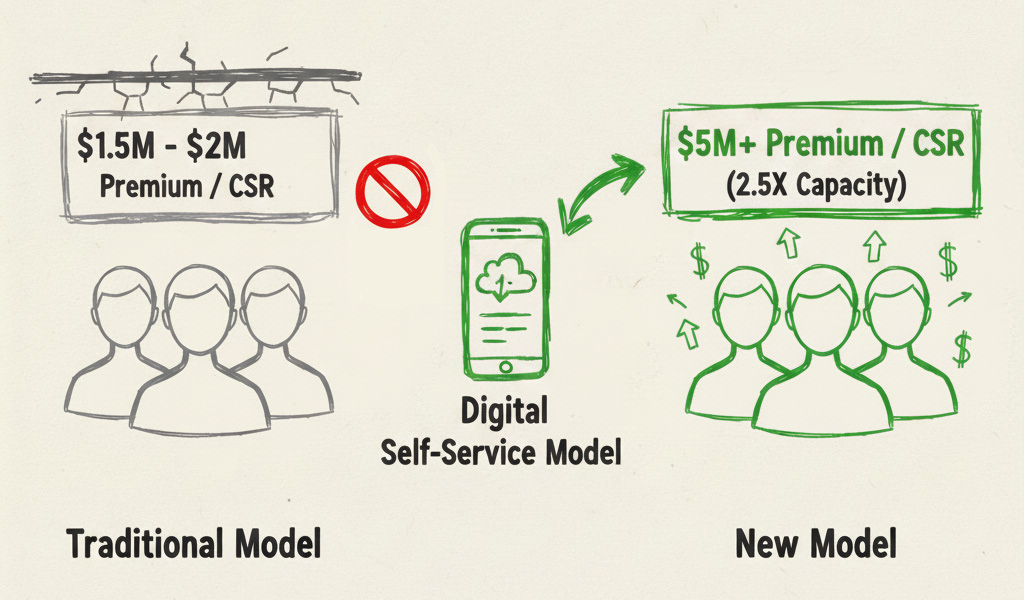
GRANT’S OWN WORDS (FROM THE INTERVIEW): “Each CSR is handling about $5 million in premium on their own. Whereas we see the typical service person in a more manual-style agency only able to handle between $1.5 to $2 million of premium before they cap out and you need to hire another service person. So each CSR is handling over two times the amount of premium that you typically see because of it. And I really relate that directly to the self-service model. The difficult thing for us to track is how much service has actually been removed. How do you commit a crime that hasn’t been committed yet? Nobody’s called us. Nobody has called to say ‘can you send me my ID cards?’ They’re just doing it through the app. Nobody has called and said ‘can I update my billing?’ They’re just doing it through the app. So if we don’t get the call, we can’t really track the direct impact of it. But what we do see from the other side of it is that each service person is handling $5 million in premium—and that’s possible because the self-service model has reduced that service weight with the clients that have downloaded it and are willing to self-serve.”
Case Study #1: How Erb & Young Doubled Revenue While Expanding CSR Capacity by 2X
Meet Brett Young, CEO of Erb & Young Insurance, a property and casualty agency based in Central Florida with 12 offices.
When Brett came to us, his agency was doing $3 million in revenue.
In just three years, they surpassed $6 million—doubling in size.
But here’s what’s even more remarkable:
They didn’t double their service staff to handle the growth.
In fact, they did the opposite.
Before implementing the Digital Self-Service Model, Erb & Young was managing 600-700 households per CSR.
Today, they’re managing 1,300-1,400 households per CSR—nearly double the capacity.
Here’s Brett in his own words:
“The primary problem in the agency was finding, developing, and retaining human capital to deliver the product that we deliver—insurance. If we can expand the capacity of each one of those people, then it gives us inherently the biggest leverage point that you can have in an agency.”
The Problem:
Like most agencies, Erb & Young was hitting a growth plateau.
They had a strong new business engine. But every time they brought on new clients, they had to hire more CSRs to handle the service load.
And even with more CSRs, they were still bottlenecked.
Brett saw it firsthand when acquiring other agencies:
“We’ve bought seven businesses in this industry. They just hit plateaus. And the biggest reason they hit plateaus is people. They reach a capacity in which they just can’t get over the hump.”
The Solution:
Brett implemented the Digital Self-Service Model to create what he calls “a multiplier of effort” for his service staff.
Instead of hiring more CSRs to handle the growing service load, he gave his existing CSRs the tools to handle 2X the volume—without working 2X the hours.
The Results:
- Revenue doubled from $3M to $6M in 3 years
- Households per CSR nearly doubled (from 600-700 to 1,300-1,400)
- CSRs wrote 1,200+ new business policies last year (because they had time to focus on revenue-generating work instead of $0.08 tasks)
- Service staff now earning higher compensation (because they’re managing more households and writing more new business)
Here’s What This Looks Like in Practice:
Let’s say a client needs a certificate of insurance for their landlord.
Old way:
- Client calls your office (or leaves a voicemail)
- CSR stops what they’re doing to answer the phone
- CSR looks up the policy in the AMS
- CSR generates the certificate
- CSR emails it to the client
- Total time: 10-15 minutes of CSR labor
New way (Digital Self-Service Model):
- Client opens the app on their phone
- Client clicks “Request Certificate”
- System auto-generates the certificate and emails it to the client
- Total time: 30 seconds. Zero CSR involvement.
Same result. Zero labor cost.
Now multiply that by 50-100 certificate requests per month.
That’s 83-166 hours of CSR time saved every single month.
At $28/hour, that’s $2,324 to $4,648 in monthly labor savings.
That’s $27,888 to $55,776 per year.
And that’s just certificates. We haven’t even talked about ID cards, billing inquiries, policy document requests, or service change requests.
Now you see why Grant Weber’s CSRs can handle $5 million in premium each instead of $1.5 million.
THE RETENTION PARADOX:
Here’s the thing most agency owners get wrong:
They think that reducing human touchpoints will hurt client retention.
They think clients will feel neglected. They think relationships will suffer. They think clients will leave for a competitor who “cares more.”
But the opposite is true.
Think about your bank again.
Would you leave your bank that gives you a mobile app, instant access, and 24/7 self-service for a bank that forced you to call during business hours and wait on hold?
Hell no.
The bank that gives you MORE control and MORE convenience is the bank you’re LESS likely to leave.
The same is true for insurance.
Your clients don’t want to call you to pull a certificate. They want instant access.
Your clients don’t want to wait 4 hours for Sarah to get back from lunch. They want to download their ID card at 10 PM on a Saturday when they actually need it.
Self-service doesn’t hurt loyalty. It INCREASES it.
Because you’re making their lives easier. You’re giving them control. You’re eliminating friction.
And when a client is happy with how easy it is to do business with you, they’re not shopping around.
SIMPLIFICATION (YOU ALREADY HAVE 80% OF WHAT YOU NEED):
Now here’s the best part:
You already have everything you need to implement this.
You have clients. You have policies. You have documents. You have an agency management system.
You just need a system that gives your clients direct access to those documents without going through your CSRs.
That’s it.
You don’t need to rebuild your entire operation. You don’t need to hire a tech team. You don’t need to change carriers or rewrite policies.
You just need to plug in the Digital Self-Service Model and let it do the work.
The system integrates with your existing AMS (Applied, Hawksoft, Vertafore, etc.). It automatically syncs your client data. It pulls policy documents directly from your carriers. It sends automated invites to your clients to download the app.
You set it up once. And it runs on autopilot.
Your clients download the app. They log in. They have instant access to everything. And your CSRs stop getting calls for document retrieval.
It’s that simple.
HIGH-TOUCH FOR EVERYTHING VS. HIGH-TOUCH FOR WHAT MATTERS:
Here’s the reframe:
You don’t need to provide high-touch service for EVERYTHING.
You need to provide high-touch service for what actually matters.
Pulling a certificate of insurance? That’s not high-touch. That’s transactional.
Downloading an ID card? That’s not relationship-building. That’s document retrieval.
Answering “what’s my policy number?” That’s not expertise. That’s data lookup.
None of that requires a human.
But you know what DOES require a human?
- Having a conversation with a client about their coverage gaps
- Walking them through a complex claim
- Cross-selling a commercial policy because you noticed they started a side business
- Calling them 30 days before renewal to review their policy and make sure nothing changed
- Building a relationship so they refer their friends and family
THAT’S high-touch service.
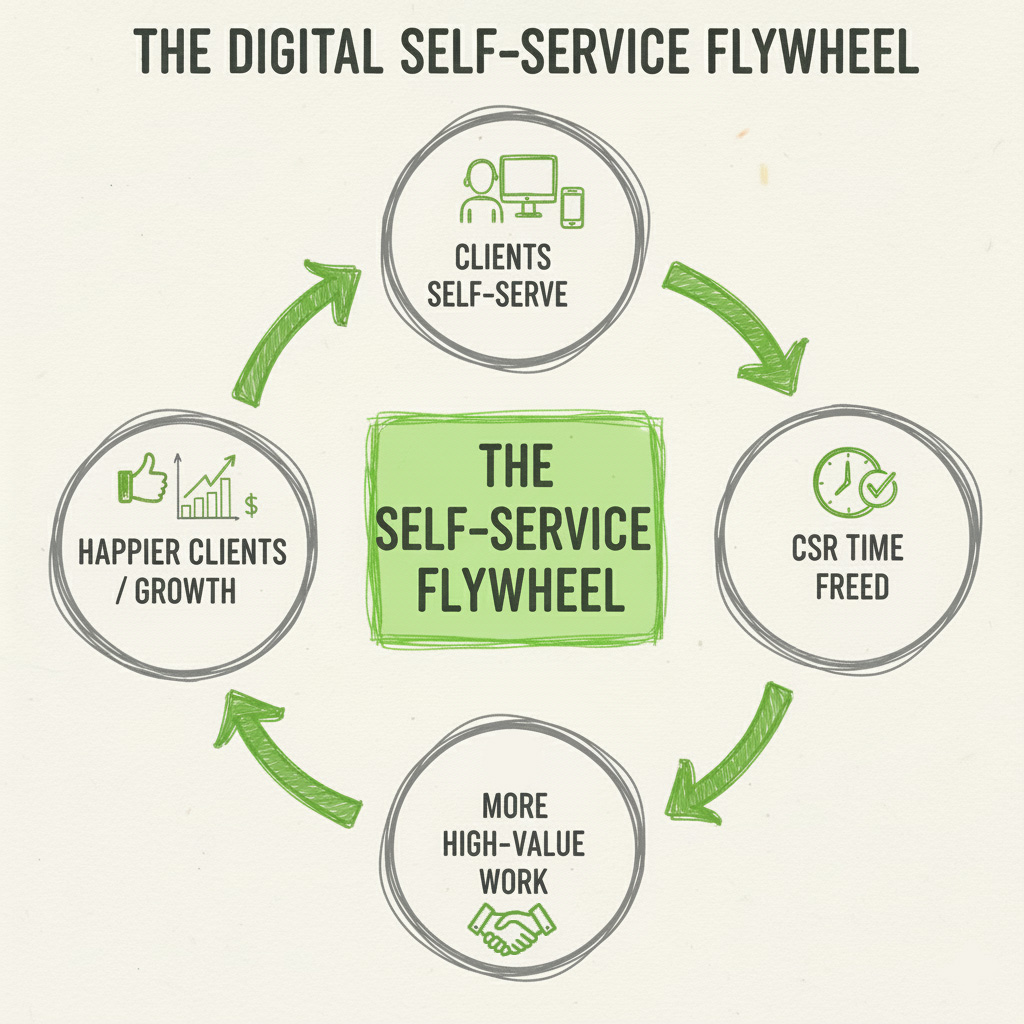
And your CSRs can’t do that work if they’re spending 70% of their day pulling certificates.
The Digital Self-Service Model doesn’t eliminate high-touch service. It enables it.
Because when your CSRs aren’t drowning in transactional requests, they can finally do the work that actually builds relationships, prevents churn, and generates revenue.
THE FUTURE IS ALREADY HERE:
Here’s the reality:
The Digital Self-Service Model isn’t optional anymore. It’s inevitable.
Your clients already expect it. They have mobile apps for their bank, their credit card, their mortgage, their utilities, their gym membership.
Why wouldn’t they expect one for their insurance?
And if you don’t provide it, your competitors will.
The agencies that adopt this model are going to scale faster, operate more efficiently, and retain clients at higher rates.
The agencies that don’t are going to keep hiring more CSRs, burning them out, and watching their profit margins shrink.
The choice is yours.
So here’s what I want to show you next:
On the next page, I’m going to walk you through exactly how the Digital Self-Service Model works, how to implement it in your agency (it’s easier than you think), and how to get your clients to actually use it (because adoption is everything).
I’m also going to show you the exact ROI calculator so you can see how much money this will save you in Year One based on your current CSR headcount and service volume.
And I’m going to introduce you to the only platform I recommend for independent agencies that want to implement this without the headache of managing the tech themselves.
But before we get there, I need you to understand one thing:
This isn’t about replacing your CSRs. It’s about freeing them up to do the work they were actually hired to do.
It’s about giving your clients the instant access they want. It’s about eliminating the Service Tax. And it’s about building an agency that can scale without burning out your team.
Ready to see how it works?