What Is the Service Tax (And How Much Is It Costing You)?
On this page, We’ll show you exactly what the Service Tax is, the three ways it shows up in your agency, and how to calculate how much you’re losing to it every single year.”
Let me tell you a story about a guy named Mike.
Mike owns a roofing company in Tampa. Last year, he did $2.3 million in revenue. Good year. But his profit margins were terrible—around 8%.
He couldn’t figure out why.
His crews were great. His sales process worked. His marketing was solid. But every time he looked at his P&L, the numbers didn’t make sense.
So he hired a consultant.
The consultant spent two weeks analyzing his business. And what he found shocked Mike.
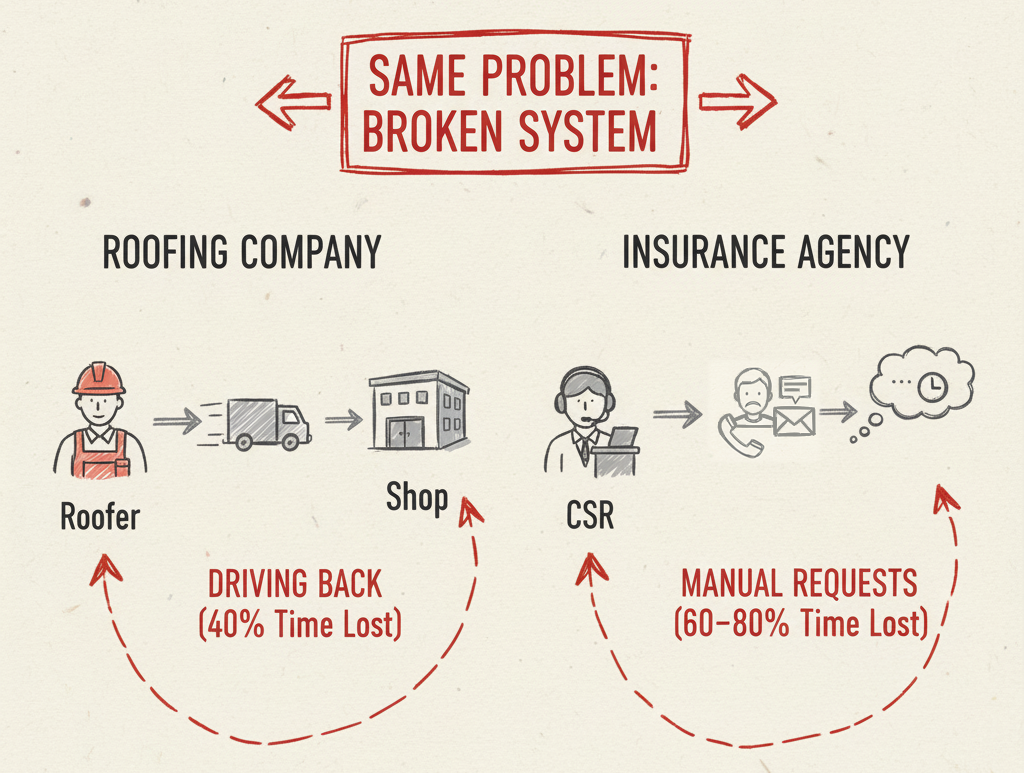
Mike’s crews were spending 40% of their time driving back to the shop to pick up materials they forgot.
Think about that.
40% of his labor cost—his biggest expense—was being spent on completely unproductive driving time.
Mike wasn’t losing money because his crews were bad. He was losing money because his system was broken.
The solution wasn’t to hire better roofers or work longer hours. The solution was to put a mobile inventory system in the trucks so crews never had to drive back to the shop.
One structural change. Profit margins went from 8% to 19% overnight.
Same crews. Same clients. Different system.
Now let me ask you something:
Yes, “roofing” is different than “insurance, but what if your agency has the same problem?
What if you’re not struggling because your CSRs aren’t working hard enough?
What if you’re struggling because the system they’re working within is fundamentally broken—and no amount of “working harder” will ever fix it?
That’s exactly what the Service Tax is.
It’s the hidden cost of running a high-touch service model in a world that doesn’t need it anymore.
And just like Mike’s roofing crews driving back to the shop, you can’t see it—but it’s bleeding you dry.
DEFINITION OF THE SERVICE TAX:
The Service Tax is the total cost of having your CSRs manually handle transactional requests that your clients could (and want to) do themselves.
It shows up in three places:
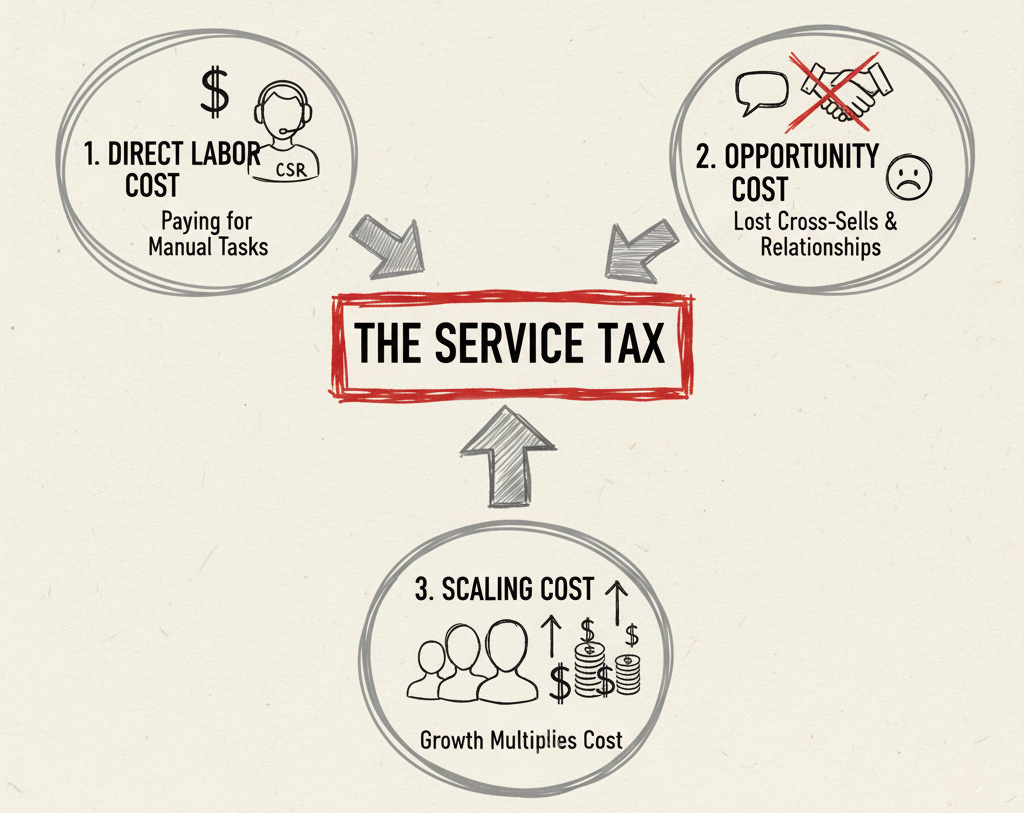
1. DIRECT LABOR COST
This is the easiest one to see (but most agency owners still miss it).
Every time a CSR manually pulls a certificate of insurance, downloads an ID card, or emails a policy document, that’s paid labor time being spent on a task that generates zero revenue and requires zero expertise.
Let’s do the math:
- Average CSR salary: $45,000/year
- Average hourly cost (with benefits/overhead): $28/hour
- Percentage of time spent on transactional requests: 60-80%
That means you’re paying $27,000 – $36,000 per year, per CSR, for work that shouldn’t require a human.
If you have 3 CSRs, that’s $81,000 – $108,000/year in direct labor cost spent on document retrieval.
Not relationship building. Not cross-selling. Not retention.
2. OPPORTUNITY COST
This is the one most agency owners never calculate (and it’s the most expensive).
Every hour your CSR spends pulling certificates is an hour they’re NOT:
- Having meaningful conversations with clients
- Identifying coverage gaps
- Cross-selling additional policies
- Building relationships that prevent churn
Let’s say your average CSR could realistically cross-sell or upsell 2 additional policies per month if they had the time to actually talk to clients.
Average commission per policy: $500
That’s $12,000/year in lost revenue per CSR.
Multiply that by 3 CSRs, and you’re looking at $36,000/year in lost commissions—just from the opportunities your team is missing because they’re too busy being a document retrieval service.
3. SCALING COST
This is the killer.
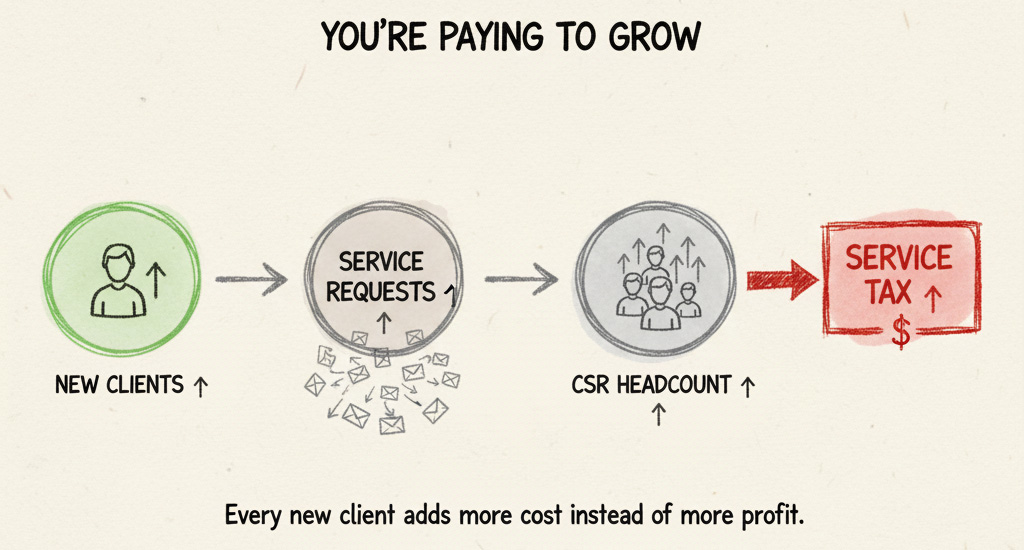
Every time you add a new client, you add more service burden to your already overwhelmed CSRs.
Which means every time you grow, you have to hire more CSRs just to keep up with the transactional volume.
Growth becomes a cost center instead of a profit center.
Here’s what that looks like in real numbers:
- You add 100 new clients
- Those clients generate an average of 15 service requests per year each
- That’s 1,500 additional transactional requests your CSRs have to handle manually
- At an average of 10 minutes per request, that’s 250 hours of additional labor
- Which means you need to hire another CSR just to handle the volume
You’re literally paying to grow.
And the worst part? The more successful you are at bringing in new clients, the more expensive your service model becomes.
Here’s how to calculate your Service Tax:
Take out a piece of paper (seriously, do this right now).
Step 1: How many CSRs do you have?
Step 2: What percentage of their time is spent on transactional requests? (certificates, ID cards, policy documents, billing questions, etc.)
Step 3: What’s their average fully-loaded hourly cost? (salary + benefits + overhead, divided by 2,080 hours/year)
Formula:
Service Tax = (Number of CSRs) × (% of time on transactional work) × (Hourly cost) × (2,080 hours/year)
Example:
- 3 CSRs
- 70% of their time on transactional work
- $28/hour fully-loaded cost
Service Tax = 3 × 0.70 × $28 × 2,080 = $122,304/year
That’s $122,304 you’re paying every single year for work your clients would rather do themselves.
And that’s JUST the direct labor cost. It doesn’t include the opportunity cost or the scaling cost.
Now here’s the part that pisses us off:
It’s not your fault.
You’ve been told for years that “great service” means being available 24/7.
You’ve been told that clients expect white-glove, high-touch attention.
You’ve been told that being responsive and accessible is what makes you different from the big carriers.
And all of that is true—for the things that actually matter.
But here’s what nobody told you:
Your clients don’t want you to pull their certificates. They want instant access to pull them themselves.
They don’t want to wait 4 hours for Sarah to get back from lunch. They want to log in at 10 PM on a Saturday and download their own ID card.
They don’t want high-touch service for transactional requests. They want self-service.
And by forcing them to go through your CSRs for every little thing, you’re not providing great service—you’re creating friction.
I was talking to an agency owner in Columbus, Ohio last month. His name was Dave. $4.2 million in revenue. 6 CSRs. Been in business for 23 years.
I asked him: “What percentage of your CSRs’ time is spent pulling certificates, downloading ID cards, and answering basic policy questions?”
He said: “I don’t know. Maybe 40%?”
So I had him track it for a week.
Turned out it was 78%.
78% of his $270,000 annual CSR payroll was going toward document retrieval.
That’s $210,600 a year.
And when I asked him, “Do your clients WANT to call your office and wait for someone to pull their certificate? Or would they rather just log in and download it themselves at 10 PM on a Saturday?”
He laughed and said, “Yeah, they’d rather do it themselves. They tell us that all the time. We get emails at 9 PM asking for certificates they need first thing Monday morning.”
So why are you forcing them to go through your CSRs?
He didn’t have an answer.
Because the truth is, he’d never questioned it. It’s just the way it’s always been done.
But “the way it’s always been done” is costing him over $200,000 a year.
Here’s where most agency owners make the biggest mistake:
They see the problem. They recognize that their CSRs are drowning. They know the service burden is unsustainable.
So what do they do?
They hire more CSRs.
And that makes the problem worse.
Here’s why:
When you hire more CSRs to handle the transactional volume, you’re not fixing the root cause—you’re just adding more capacity to a broken system.
It’s like Mike’s roofing crews. If Mike had hired more roofers to handle the workload, they’d still be spending 40% of their time driving back to the shop. More people doesn’t fix a structural problem.
Hiring more CSRs doesn’t eliminate the Service Tax. It multiplies it.
Because now you have:
- More salaries to pay
- More benefits and overhead
- More people doing low-value work
- More opportunity cost (because now you have MORE people who aren’t cross-selling or building relationships)
And when you add your next 100 clients, you’ll need to hire ANOTHER CSR to keep up.
The Service Tax scales with your headcount.
So what’s the real problem?
The problem isn’t your CSRs. They’re working their asses off.
The problem isn’t your clients. They’re not being unreasonable.
The problem is the structure.
You’re running a high-touch service model in a world that no longer needs it for transactional requests.
Your clients want self-service. They want instant access. They want to pull their own documents at 10 PM on a Saturday without having to wait for your office to open on Monday.
But your agency doesn’t offer that. So they’re forced to go through your CSRs.
And your CSRs are forced to spend 70% of their time doing work that doesn’t require their expertise, doesn’t generate revenue, and your clients would rather do themselves.
It’s a lose-lose-lose.
You lose because you’re paying six figures in Service Tax.
Your CSRs lose because they’re drowning in low-value work.
Your clients lose because they don’t have the instant access they want.
But here’s the good news:
There’s a different way.
A way that eliminates the Service Tax entirely.
A way that frees up your CSRs to do the high-value work they were actually hired to do.
A way that gives your clients the instant access they want—without adding headcount, without increasing overhead, and without sacrificing the relationships that actually matter.
It’s called the Digital Self-Service Model.
And on the next page, I’m going to show you exactly how it works, why it’s the future of independent agencies, and how one agency used it to cut their Service Tax by $140,000 in the first year—without losing a single client.